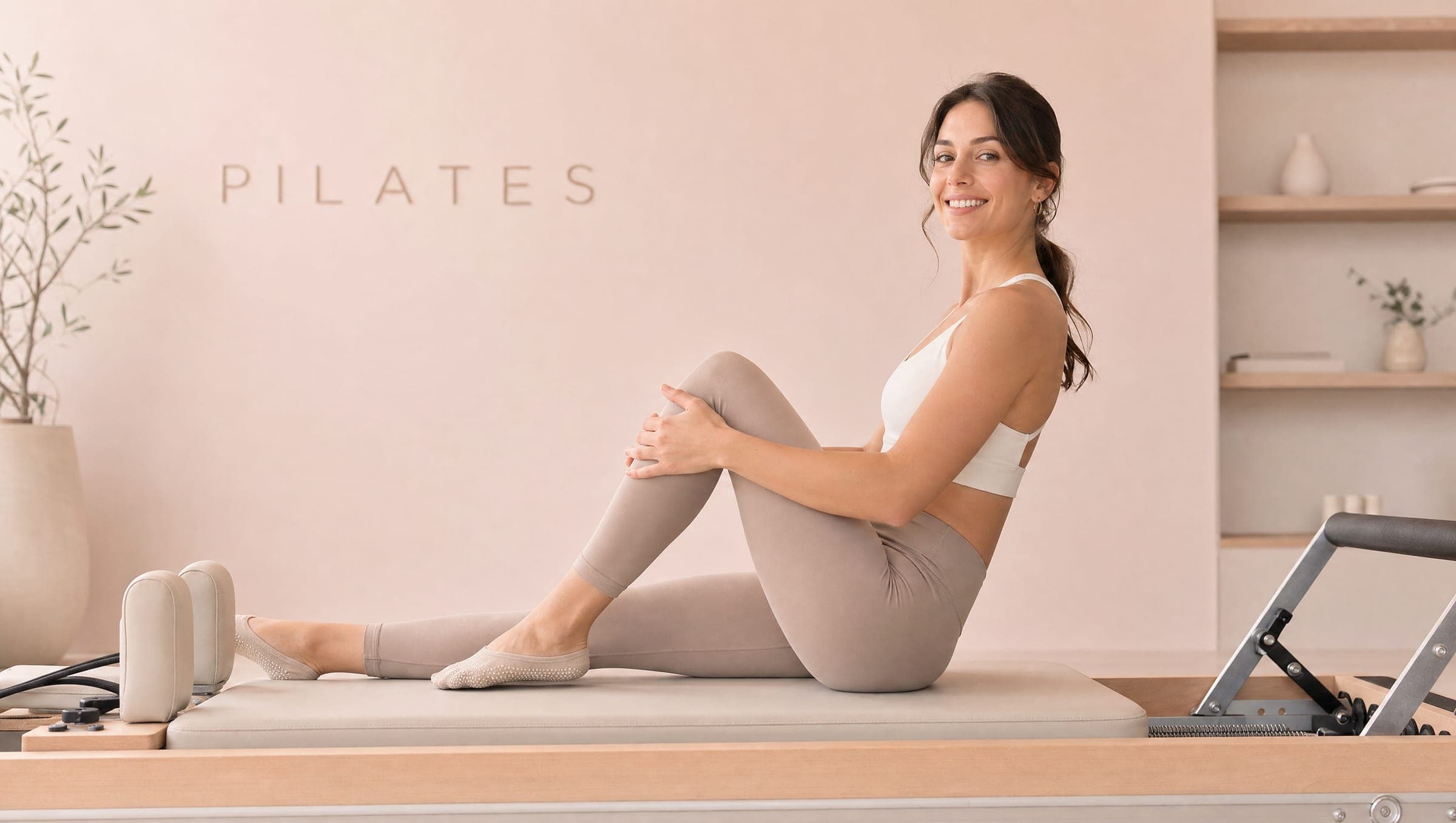
Grip socks vs normal socks for Pilates: what actually changes under your foot
The first time I wore plain trainer socks to a Reformer class, I slid off the footbar mid-lunge and grabbed the shoulder rest like it owed me money. That was about nine years ago. I've worn a lot of socks since, good and bad, and tested grip against plain in the most boring way possible: the same foot, the same carriage, back to back. So when someone asks whether grip socks really beat normal socks for Pilates, I'm not guessing.
The honest answer has two parts. For anything on a Reformer or a sweaty mat, it isn't close. For slow mat work at home, you can sometimes get away with plain socks. Here's where the line actually sits, and why.
Grip socks vs normal socks, side by side
Same nine criteria, both options, no thumb on the scale. This is the version I'd text a friend before her first class.
| What you care about | Grip socks | Normal socks |
|---|---|---|
| Footing on a Reformer carriage | Holds through spring-loaded pushes | Slides on the first push |
| Footing on a sweaty mat | Stays planted | Slips once sweat soaks the sole |
| Studio approval | Accepted (often required) | Usually turned away on equipment |
| Hygiene on shared apparatus | Barrier between foot and surface | Same barrier, minus the grip |
| Foot feedback / proprioception | Slightly muted by the silicone | Marginally better, but you trade away grip |
| Grip lifespan | 100+ studio wears for a good pair | No grip to lose, but no grip to start |
| Typical price each | $14–22 for a studio-grade pair | $2–5 for a multipack athletic sock |
| Best use | Reformer, Barre, hot Pilates, hardwood | Slow mat work at home on carpet or a sticky mat |
| What fails first | Cotton wears before silicone | Your footing, immediately |
The table answers the buying question. The rest of this post is the why, because the why is what tells you when the cheap option is a false economy and when it's genuinely fine.
Do grip socks actually grip better than normal socks?
Yes, and the gap is bigger than people expect. Grip socks are athletic socks with silicone printed on the sole, so the silicone creates friction against a Reformer carriage, a mat, or a studio floor. Normal socks are woven cotton or polyester with nothing on the bottom, so the only thing resisting a slide is the fabric's own texture, which is almost nothing once there's any moisture involved.
I ran the dullest test I could think of. Same right foot, same Reformer, light spring. Plain combed-cotton crew sock first: I pressed into the footbar for ten single-leg reps and counted how many times my foot crept forward. It crept on all ten, and twice it slid enough that I reset my stance. Then the grip pair, same ten reps. My foot didn't move once. That's not a lab with a force plate, it's one founder and one carriage, but the result has been the same every time I've repeated it across three studios.
The reason the difference is so stark is that Pilates loads your foot at an angle. You're rarely pressing straight down. You're pushing out and away against a spring that wants to send the carriage back at you. Straight-down weight, a plain sock can sort of handle. Angled shear force is exactly what plain cotton can't hold.
Why normal socks slip (it's the material, not just the missing dots)
People assume the only difference is "one has grippy dots." The bigger issue is the fabric itself. Cotton's coefficient of friction against a smooth vinyl carriage is low to begin with, and it drops further the second sweat gets between the sole and the surface. Add a polyester blend and it gets slicker still, because polyester sheds moisture onto the contact surface instead of absorbing it.
So a normal sock fails twice. It has no silicone, and the fabric it does have turns into a worse version of itself as you warm up. By minute 30 of a heated class, a plain sock on a vinyl carriage behaves a lot like a wet sock on a tile floor. The silicone on a grip sock sidesteps the whole problem, because cured silicone holds its friction whether it's dry or damp.
This is also why a "thicker" or "more expensive" normal sock doesn't fix it. Cushioning has nothing to do with grip. I've seen people show up in $18 merino running socks and slide just as much as the $3 pair, because the variable that matters isn't sock quality, it's whether there's silicone on the sole.
When are normal socks actually fine for Pilates?
Here's the part most comparison posts skip, because conceding anything feels off-brand. But trust matters more than the sale, so: there are real cases where plain socks are fine.
- Slow mat work at home on a non-slip surface. Roll-downs, bridging, gentle core work on a sticky yoga mat or carpet. If your foot isn't pushing against a spring and the surface already grips, plain socks are okay.
- Pure floor stretching with no standing transfers. If you never load the foot laterally, you never test the thing grip socks are for.
- When you genuinely prefer more foot feedback and you're staying off equipment. A bare sole reads the floor slightly better than one with silicone on it. That's a real, if small, trade.
Notice what every one of those has in common: low movement, no equipment, a surface that's already non-slip. The moment you add a Reformer, a Barre, heat, or a hardwood floor, the case for normal socks disappears. And if you're in a studio at all, the decision is usually made for you, which brings us to the rule nobody explains.
The hygiene rule most studios won't explain
Most Pilates and Barre studios in the US, UK, and Australia require grip socks on equipment, and a lot of front-desk staff frame it as a slip-safety thing. That's half of it. The other half is hygiene. Bare feet and the sweat they leave behind sit on a carriage that the next twelve people will also press their faces toward during footwork. Socks put a barrier between skin and shared apparatus.
Here's the catch that makes plain socks pointless in a studio: they give you the hygiene barrier but cost you the grip. So you've satisfied the cleanliness reason and failed the safety one. A grip sock is the only option that covers both, which is why studios specify grip and not just "socks." If you've ever been handed a pair at the desk for $12 because you forgot yours, that's the policy in action.
What to look for if you're switching from normal socks
If this is the post that finally convinces you, don't just grab the cheapest grip pair, because a bad grip sock can underperform a good plain one for comfort. Three things decide it: full-sole silicone instead of scattered dots, a real cotton percentage on the label (I look for 70%+ combed cotton), and a woven arch band so the sock doesn't twist mid-class. I broke all of this down in why grip socks matter in Pilates, and the Reformer-specific buyer's guide covers the specs that fail by week three.
One more thing the price table doesn't show: a good grip pair lasts. Wash it cold and air dry it and the silicone outlives the cotton, which is the whole point of the care routine. I wear-test every pair we make across Miami studios before it ships, and the protocol for that is on our testing methodology page. A normal sock costs less per pair, but you're paying for grip you don't get, so per useful class it's the worse deal.
So, do you need grip socks for Pilates?
If you take class in a studio, on any equipment, or anywhere with heat or a hard floor: yes, and normal socks aren't a real alternative. The footing gap is immediate and the studio will likely require grip anyway.
If you only ever do slow mat work at home on a sticky surface and never touch a Reformer: plain socks can do the job, and you don't need to spend anything.
Choose grip socks if you're on a Reformer, a Barre, a hardwood floor, or you sweat. Stick with normal socks if your whole practice is gentle, home-based, equipment-free mat work on a non-slip surface, and you don't care about the small hygiene gap. For everyone in between, which is most people who actually go to class, the comparison is settled before it starts. Get one good pair, wear it, and you'll feel the difference on the first spring-loaded push.
If you want to start with a pair built to the spec above, our Soft Pilates Set is the everyday version I wear-test myself.
Frequently asked
Can I just wear normal socks until my grip socks arrive?
For a home mat session on carpet, fine. For a studio Reformer class, no, and most studios won't let you on the equipment anyway. Borrow or buy a pair at the desk rather than risk a slide.
Are grip socks worth the extra money over normal socks?
Per pair, grip socks cost more. Per useful class, they cost less, because a normal sock gives you zero of the grip you went to class for. A good grip pair lasts 100+ studio wears, so the cost-per-class math favors it.
Do grip socks feel different from normal socks?
A little. You feel the silicone under the ball of your foot, and the arch band sits snugger than a plain sock. Most people stop noticing within a class. The trade for that small change in feel is footing you can actually trust.
What about anti-slip slipper socks from a pharmacy?
Closer than plain socks, but the dotted hospital-style grip is spaced too far apart for a Reformer footbar and the cotton is usually thin and low-quality. They'll keep you upright on a kitchen floor, not through single-leg footwork.
Will grip socks help if I do hot Pilates?
That's where the gap is widest. Heat and sweat are what destroy a plain sock's already-weak grip, while cured silicone holds friction wet or dry. If you do anything heated, grip socks aren't optional.
Ten years of sliding around taught me one thing cleanly: the difference between grip socks and normal socks for Pilates isn't a feature, it's whether your foot stays where you put it. Everything else is detail.
References
- TODO — Pilates Method Alliance equipment hygiene / grip-sock requirement guidance
- TODO — Coefficient-of-friction reference: cotton vs. silicone on vinyl, dry vs. wet
- TODO — Cotton Inc. moisture-behavior source for the "slicker as you warm up" claim
- TODO — Peer-reviewed athletic-sock slip / fall-prevention study
- TODO — Foot proprioception source for the bare-sole feedback note